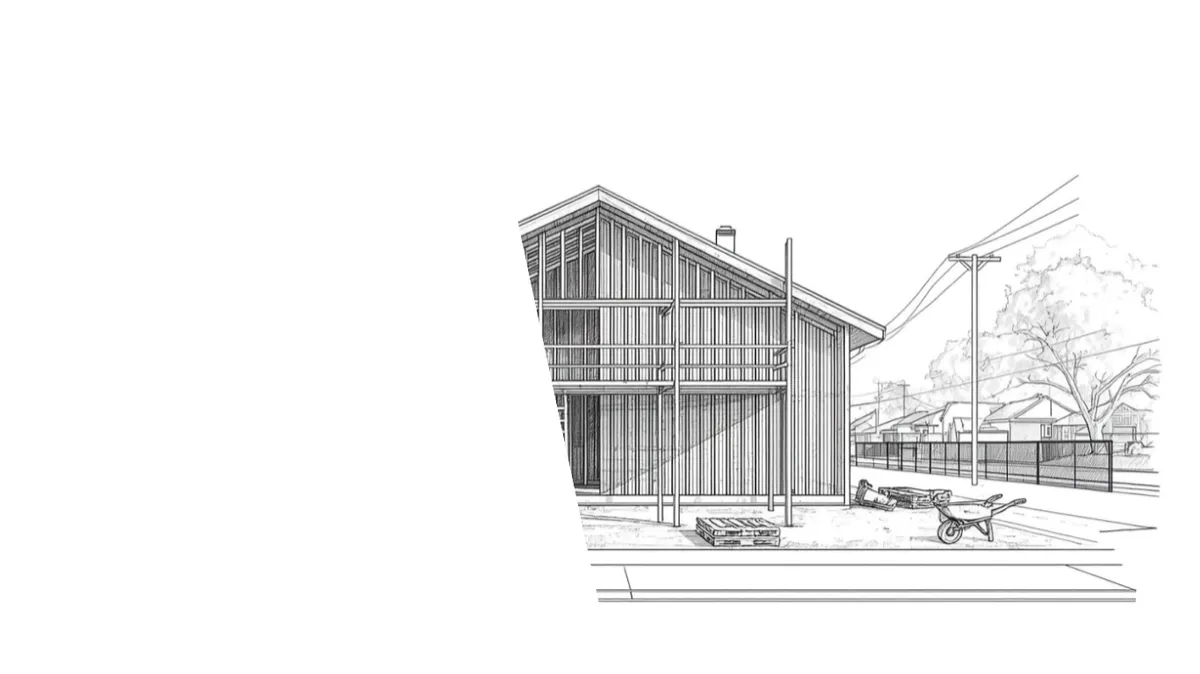
Why Building Homes in Australia Costs More and Takes Longer Than It Should
We built this problem on purpose
Building a house in Australia now costs about 40% more than it did five years ago. It takes 50% longer. And the industry that produces it has become less productive, on a per-worker basis, than it was in 1995.
That's not a pandemic hangover, it's a system working exactly as designed.
If this were any other industry - manufacturing, logistics, agriculture - the response would be a reckoning. Boards would roll. Strategies would change. Instead, the Australian construction sector keeps running the same delivery model, pricing in the same risk, and wondering why the numbers keep getting worse.
The conversation needs to change. Not because the people in the industry are doing a bad job, most are doing deserving, quality, hard work inside a broken model... but because the model itself can no longer deliver what the country now needs from it. The Housing Accord asks for 1.2 million new dwellings in five years. The current delivery system can't produce that. Not at this cost. Not at this pace. Not with this workforce.
This piece is the diagnosis. What's actually wrong, why it's wrong, and why the fix isn't more of the same.
The numbers don't flinch
Start with the evidence.
Productivity
The Productivity Commission's February 2025 paper Housing construction productivity: Can we fix it? found that physical dwelling construction productivity - the number of dwellings completed per hour worked - has fallen 53% since 1994–95. Even adjusted for larger house sizes and higher build quality, output per hour has gone backwards while nearly every other sector of the Australian economy has moved forward.
Cost
According to the ABS, house construction prices rose 40.8% between September 2020 and June 2024. Residential construction costs now sit roughly 35% higher than they did at the end of 2019. Escalation has moderated to about 3.4% annually, but RLB and Altus both forecast another 4–6% in 2026. There's no return to the old baseline. This is the new floor.
Time
Average new house completion times have blown out from 2.2 quarters to 3.3 quarters - from about six months and three weeks, pre-pandemic, to nearly ten months today. Same houses. Same materials. Same building codes. Fifty percent longer on site.
Supply
The Housing Accord target was 240,000 new dwellings a year. In 2023–24, the country built about 176,000. Year one produced a 64,000-home shortfall before the accord was really tested. Master Builders Australia's latest modelling forecasts a 262,000-home shortfall across the full five-year target.
Workforce
the industry is being asked to build the most homes it has ever built, in the shortest timeframe it has ever been given, with fewer workers, at rising cost, in a delivery model that has been getting less productive for three decades.
The HIA estimates Australia needs around 83,000 additional skilled construction workers to deliver the Accord's targets. Bricklaying, roofing, carpentry, tiling and plastering are all in acute shortage. Sixty-seven percent of small builders report trouble recruiting or retaining skilled tradies.
Put those numbers together and a clear picture emerges: the industry is being asked to build the most homes it has ever built, in the shortest timeframe it has ever been given, with fewer workers, at rising cost, in a delivery model that has been getting less productive for three decades.
This is not a cyclical problem. It's a structural one.
The system is behaving exactly as it was built to behave
There's a comforting story the industry likes to tell itself: the problems are external. Interest rates. Material supply. Global conflict. Weather. Council processing times. Each of these is real. None of them is the cause.
The cause is the model.
Australian residential construction is built around a few structural choices that looked reasonable in a cheaper, slower, more predictable economy - and now quietly strangle output in every project they touch.
First: almost all of the work happens on the critical path
On a traditional build, framing can't start until the slab is cured. Lockup can't start until the frame is up. Roofing waits for framing. Plumbing waits for roofing. Linings wait for plumbing. The whole program is a single file line of trades, each dependent on the last, each exposed to weather, supply delays, and labour availability. Lose a week to rain in any one of those trades and you lose a week off the whole schedule.
Second: the labour model is fundamentally fragmented
A single house is delivered by a chain of independent subcontractors - often twenty or more - coordinated by a builder who takes the risk on all of them showing up on time. When any one of them is tight on workers (which, right now, is most of them) the chain breaks. There is no buffer. There is no redundancy. There is no factory floor waiting in reserve.
Third: the cost structure assumes site-based risk is free
Under the current model, the cost of weather, coordination, trade delays, defects, rework, and insurance is baked into every price. Builders aren't gouging. They're pricing for a delivery method where a non-trivial percentage of every programme will be lost to things nobody controls.
Fourth: the regulatory and procurement environment rewards sameness
Standard detailing, standard materials, standard supervision, standard finance pathways. Anything new; a different structural system, a different delivery sequence, a different warranty chain - gets treated as “alternative” and pushed through the same assumptions the system was built around. This punishes innovation at precisely the moment the industry needs it most.
None of this is anyone's fault. But it is definitely the model's fault. And the honest answer is that no amount of reform at the edges - faster approvals, more apprentices, targeted migration, incentive payments, stamp duty tweaks - will fix a delivery system that adds cost and consumes time by design.
You can't train your way out in five years
The workforce arithmetic is the cleanest illustration of how broken the model is.
Australia needs roughly 83,000 additional construction workers to meet its housing targets. The apprentice pipeline isn't producing that. Migration isn't delivering it fast enough. Even if it were, it would take years to reach productive site capacity.
Meanwhile, the existing workforce is ageing. A significant share of the trades that matter most; bricklayers, carpenters, roof tilers - are within a decade of retirement. Apprenticeship completion rates in residential trades have been falling for years. And every trade that leaves the industry takes with it the only thing that made the old model work at all: experience.
The hard conclusion is that the labour shortfall is not solvable inside the current model. Training is important. Migration is important. Retention is important. But they are not fast enough, at scale, to deliver 240,000 homes a year under a delivery method that needs every one of those workers on site, in sequence, rain or shine.
So the real question becomes: how do you build more homes with fewer hours on site?
That is the question the industry has been avoiding.
The same inputs will produce the same outputs
The national response to the housing crisis, so far, has been to feed more demand into the existing machine. Tax incentives. Developer contributions. Planning reform. Targeted first-home-buyer support. Build-to-rent subsidies. Public housing commitments.
All of this is directed at the demand side or the approvals side. Almost none of it is directed at how the building actually gets built.
That's the missing half of the reform agenda. You can make it cheaper to finance a home, faster to get approved, more attractive to invest in. None of that changes how many dwellings a given workforce can deliver in a given year. Until the delivery model changes, the output doesn't change - it just gets more politically expensive!
This isn't an argument against the Housing Accord. The targets are right. The ambition is right. But the delivery architecture underneath it is being quietly borrowed from the 1990s, and it is producing exactly the results that model has always produced: slower, costlier, more fragile output in every market condition that isn't mild and stable.
The industry has two choices: Keep running the same model and miss the target by a quarter of a million homes. Or change the model.
What actually changes the equation
There is a structural answer, and it is not new. It is the same answer that every other advanced construction market has been converging on for twenty years, and the one Australia has spent two decades politely ignoring: shift the work off the critical path and into a controlled environment.
Australian housing doesn't need more of what isn't working. It needs a different way to build.
Off-site construction. Modern Methods of Construction (MMoC). Prefabrication. Panelised and volumetric systems. SIPs. Hybrid delivery. The language varies. The logic does not.
The logic is this: you can't change the weather, the supply chain, or the national apprentice pipeline in the next five years. But you can change where and when the work happens. You can resolve structural design earlier. You can manufacture components in parallel with site works. You can bring factory-grade tolerances and predictable labour to the parts of a build that currently lose weeks to site conditions. You can sequence a roof, a wall, and a floor system to arrive when the slab is ready, not when a subcontractor is.
The effect on the numbers is not theoretical.
Off-site-led projects consistently report program reductions of 30–50% on structure and envelope. Labour hours on site fall, often by a larger percentage. Weather exposure halves. Defect rates drop sharply, because the work happens under cover, with better supervision, and the same crews doing the same details every week. None of this requires a new workforce. It requires a different distribution of the existing one.
The market signals are finally lining up.
PrefabAUS estimates off-site is currently around 5% of Australian residential construction and has set a target of 10% by 2030.
The Queensland Government has committed to a 50% MMoC target for government-funded projects ahead of the 2032 Olympics, with QBuild's MMoC program already delivering over 300 homes and another 600 in the pipeline.
CommBank became the first major lender to formally endorse and finance MMoC through a partnership with PrefabAUS - a direct hit on one of the oldest barriers to off-site uptake in this country.
HIA, Master Builders and the Australian Constructors Association all now have live working groups on prefab and modular delivery.
None of this is a silver bullet. Off-site doesn't suit every project. Volumetric makes sense for some typologies and not others. Panelised systems like SIPs deliver structural and thermal performance that traditional framing cannot, but they need to be designed into the project from day one, not retrofitted at tender. Hybrid delivery - off-site structure with trade finishing on site - is often the pragmatic answer in the Australian context.
What off-site is, unambiguously, is the only credible route to more output per worker, per week, per dollar, across the scale the country actually needs.
A closing note
Off-Site Logic exists because the gap between how Australia builds homes today and how it needs to build them is now too big to be closed by effort inside the old model. Bridging that gap - from feasibility, through design, into site delivery - is the work.
If you're a builder, developer or designer reading this and recognising your own project in the diagnosis: that's the starting point. The next question is what changes, at which stage of the project, to produce a different outcome. That's a longer conversation - and it's the one the next piece in this series is about.
Australian housing doesn't need more of what isn't working. It needs a different way to build.