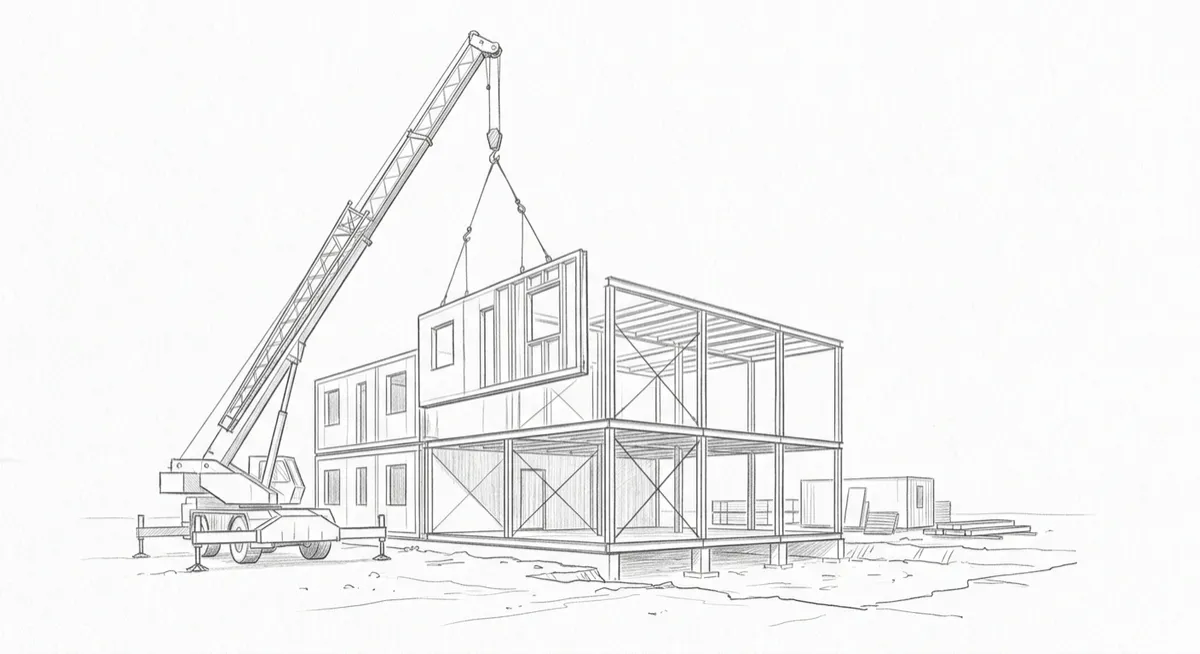
The federal government committed $54M to prefab housing - here's what happens next
Six months ago, the federal government committed $54 million to prefabricated housing.
It was a headline.... But what's actually happened since?
Here's where things stand, and what it means if you're a developer, builder, or investor watching the off-site construction space in Australia.
The $54M broke down into two buckets. $49.3 million went to states and territories to grow their local prefab programs.
The remaining $4.7 million went to the ABCB to develop a national voluntary certification scheme for prefabricated construction manufacturers.
That second piece is the one worth paying attention to.
Right now, if you want to use prefabricated elements on a project, you're navigating a different approvals process in every state. Sometimes every council. The certification scheme is designed to change that; giving manufacturers a nationally recognised credential that streamlines how their products get assessed against the NCC.
The ABCB has been working through the framework with industry and jurisdictional regulators. Draft definitions for Modern Methods of Construction (MMC) are expected for public consultation later this year, alongside the proposed certification framework itself. First accreditations are now being targeted for mid -2028... should we be confident that this timeline is accurate? History would say otherwise...
On the state side, things appear to be moving at different speeds. NSW is supposedly the furthest ahead. The Minns Government's Building Productivity Reforms are set to go before Parliament this year, proposing a single statewide approval pathway for prefabricated buildings; replacing the current patchwork of individual council processes. If that passes, it's a genuine shift in how off-site construction gets treated at the regulatory level.
Queensland released its response to the Productivity Commission's report on construction industry efficiency in January. And on the ground, investment is starting to flow, Oly Homes has said they are building a 21,900 sqm factory on the Sunshine Coast, expected to take their output from around 200 homes to 550 annually.
That's real capacity coming online. So what does this mean practically?
The policy direction is set. But the regulatory infrastructure (that's been the headache for developers and builders across the industry for the last decade) is still being built.
And that's the gap that tends to get overlooked.
Funding announcements are easy. Building the approvals framework, getting eight states and territories aligned, creating a certification process that manufacturers can actually use - that's the hard part. And it takes longer than a budget cycle.
For developers looking at prefab for upcoming projects, the question isn't whether the sector is heading in the right direction. The question is whether you're making decisions based on where the regulations are today, or where they'll be in 18 months.
Those are two very different conversations.
The off-site sector in Australia is at a genuine inflection point. The funding, the policy intent, and the industry capability are all converging. But the speed at which the regulatory framework catches up will determine whether that $54 million turns into a catalyst... or just supports more government start-up infrastructure set to fizzle out after 24 months
The next 12 months will tell us a lot.
Where are you sitting on this, waiting for the regulatory framework to land, or already making prefab work under the current conditions? Drop a comment or send a message.